
Virginia's Low Voltage Cabling Contractor for Homes, Businesses & Government
Structured cabling, fiber optic, server room buildouts, and electronic security system installation — designed, installed, and certified by Class A licensed, DCJS-licensed technicians.
Commercial & Residential Low Voltage Solutions
Two specialized service tracks — each with a dedicated quote process and field team.
Enterprise-Grade Structured Cabling
From small office buildouts to multi-floor enterprise networks, government facilities, warehouses, and military installations — Mercury designs and installs structured cabling systems built for today's operations and tomorrow's growth.
- Cat6A data cabling — offices, medical, retail, industrial
- Fiber optic backbone and horizontal runs
- Server room and network closet buildouts
- Access control and IP camera infrastructure (DCJS licensed)
- Government and federal facilities (SDVOSB, SeaPort-NxG)
- E-Rate eligible school and library installations
- Shipboard and maritime cabling (Cableway certified)
Whole-Home Network Infrastructure
Whether you're building new, renovating, or upgrading an existing home, Mercury's residential team installs clean, organized, and future-proof low voltage systems that keep every room connected at full speed.
- Cat6 wired network drops — every room and office space
- Structured media center (SMC) installations
- Whole-home Wi-Fi access point infrastructure
- Security camera and doorbell wiring (DCJS licensed)
- Home theater and distributed audio/video
- Smart home device integration
- New construction and retrofit installations
Poorly Installed Cabling Costs More Than the Installation
Low voltage cabling is the physical foundation of every device on your network. When it's done wrong — wrong cable category, improper terminations, inadequate testing — the problems compound and become expensive to fix.
Virginia requires a Class A Contractor License for low voltage work and a separate DCJS Electronic Security Business License for any security system installation. These are two distinct state requirements. Unlicensed work can void warranties, fail inspections, and expose property owners to liability.
- Network slowdowns from marginal or untested cable runs
- Failed inspections and downtime from uncertified work
- Expensive rework when technology requires proper cabling
- Security system liability from non-DCJS-licensed installers
- Voided warranties from unlicensed contractor work in Virginia
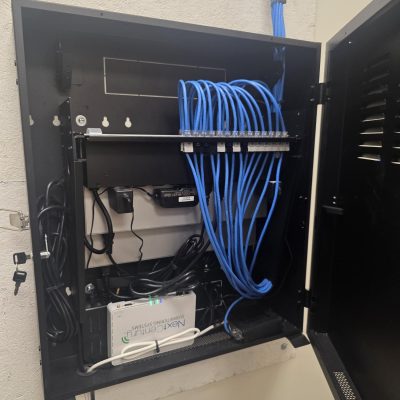
What a Professional Installation Delivers
- TIA/EIA certified performance — tested with calibrated equipment
- Clean cable management, labeling, and documentation at every point
- BICSI best practices from pathway to patch panel
- Scalability built in — ready for 10GbE, Wi-Fi 7, and beyond
- Code-compliant plenum-rated cable where required
- DCJS-licensed technicians on all security system work
- As-built drawings delivered on project completion
- Single point of accountability — licensed, bonded, and insured
Complete Low Voltage Cabling & Electronic Security Services
Every service is designed, installed, and tested by BICSI-certified, DCJS-licensed technicians to TIA/EIA standards.
Structured Cabling Design & Installation
Network backbone designed to TIA-568 standards with room to grow.
- Cat6 data cabling — residential and light commercial
- Cat6A — 10GbE-ready for commercial and enterprise
- Cat7 and Cat8 for high-density data center applications
- Plenum (CMP) and riser (CMR) rated cable where required
- Voice cabling and PBX/VoIP infrastructure
- Coaxial cabling (RG6, RG11) for video distribution
Server Room & Network Closet Buildouts
Professional rack-and-stack services with organized, labeled, documented infrastructure.
- IDF / MDF design and buildout
- Rack and cabinet installation and organization
- Patch panel installation, labeling, and documentation
- Horizontal and vertical cable management
- UPS (uninterruptible power supply) integration
- Cooling and power capacity planning coordination
Wireless Infrastructure Cabling
Proper WAP cabling is the difference between enterprise Wi-Fi and consumer-grade guesswork.
- Indoor access point cabling — ceiling and wall mount
- Outdoor and point-to-point wireless cabling
- PoE infrastructure for WAP and IP devices
- Ubiquiti, Cisco Meraki, Aruba access point installation
- High-density: hospitality, healthcare, education
Security & Surveillance System Installation
CCTV, access control, and intrusion systems installed by state-licensed security technicians.
- IP and analog CCTV camera cabling and installation
- NVR / DVR closet buildout and power infrastructure
- Access control — door readers, electric strikes, controllers
- Intrusion detection and alarm system cabling
- Intercom and video doorbell systems
- Integration with IT network cabling infrastructure
Fiber Optic Installation & Certification
Singlemode and multimode fiber for enterprise backbone, campus, and FTTx applications.
- Singlemode fiber (OS2) — long-distance and campus backbone
- Multimode fiber (OM3/OM4) — enterprise and data center
- Fusion splicing and mechanical terminations
- OTDR testing and fiber certification documentation
- Fiber troubleshooting and restoration
- FTTx — fiber-to-the-home and fiber-to-the-premises
Audio/Video & Distribution Systems
Structured A/V cabling for conference rooms, hospitality, retail, and home theaters.
- Conference room display and speaker cabling
- Distributed audio and multi-room A/V infrastructure
- Digital signage cabling and display mounting
- Home theater rough-in and structured media centers
- Coaxial CATV distribution (RG6, RG11)
- AllWorx voice system integration cabling
Why Virginia Requires Two Separate Licenses for Security System Work
Most property owners don't realize that electronic security system installation in Virginia is governed by two distinct licensing bodies. The Virginia DPOR Class A Contractor License covers low voltage and cabling work. The Virginia DCJS Electronic Security Business License specifically covers the design, installation, and service of electronic security systems — CCTV, access control, alarms, and intrusion detection.
A contractor holding only a Class A license is not legally permitted to install electronic security systems in Virginia without also holding a DCJS license. Mercury Communications holds both — Class A #2705165655 and DCJS Electronic Security Business License #11-30083 — and all field technicians performing security system work are individually registered with DCJS. Hiring a single-license contractor exposes property owners to code violations, voided warranties, and failed inspections.
Low Voltage Expertise Across Every Market Segment
From single-family homes to federal facilities — Mercury's licensed teams serve every building type across Virginia.
Residential & New Construction
Whole-home Cat6 networks, structured media centers, DCJS-licensed security camera pre-wire, and smart home infrastructure for custom builds and renovations.
Commercial Office & Retail
Tenant buildouts, office expansions, PoE infrastructure, DCJS-licensed access control, and network closet upgrades for commercial properties.
Healthcare & Medical Facilities
HIPAA-conscious structured cabling, nurse call cabling, DCJS-licensed access control and IP cameras for clinical environments.
K–12 Schools & Universities
E-Rate eligible structured cabling, campus Wi-Fi, fiber upgrades, and DCJS-licensed security systems. USAC SPIN #143054774.
Warehouses & Industrial
High-bay wireless cabling, IP surveillance, and wide-area network infrastructure for logistics and manufacturing environments.
Government & Federal Agencies
SDVOSB-certified, SeaPort-NxG prime contract holder. Navy, Air Force, Army, USDA, and AAFES facilities throughout Virginia.
Shipyards & Naval Facilities
Cableway-certified shipboard installations. Fiber optic, copper data, and power cabling to NAVSEA standards.
Hospitality & Multi-Tenant
High-density Wi-Fi cabling, distributed A/V, and guest network infrastructure for hotels and mixed-use properties.
Credentials That Protect Your Project
Every job is backed by the licensing, certification, and processes that reduce your risk as a property owner or facilities manager.
Virginia Class A Licensed & Insured
VA Class A License #2705165655. Bonded and insured for commercial and residential low voltage and electronic communications service contracting throughout Virginia.
#2705165655DCJS Electronic Security Business License
Virginia Department of Criminal Justice Services Electronic Security Business License #11-30083 — required by state law for CCTV, access control, alarm, and intrusion detection installations. Mercury holds both the Class A and DCJS license. Most low voltage contractors hold only one.
DCJS #11-30083Individually DCJS-Registered Technicians
Virginia DCJS requires not just a business license but individual technician registration for anyone performing electronic security system work. Every Mercury field technician performing security installations is individually registered with DCJS — protecting clients from liability exposure that unregistered technicians create.
BICSI Certified Technicians & Partner
BICSI membership and certified technicians ensure structured cabling best practices from pathway design through final certification — not just installation.
ISO 9001:2015 Quality Management
Third-party certified quality management system. Every project follows documented processes for consistency, safety, and customer satisfaction.
OSHA 10 Certified Workforce
Every Mercury field technician holds OSHA 10 certification. Jobsite safety is documented and enforced on every commercial and residential installation.
SDVOSB, SWaM & DBE Certified
Service-Disabled Veteran-Owned Small Business (SDVOSB). Supports contractor set-aside requirements for government and state procurement programs.
SeaPort-NxG Prime Contract Holder
SeaPort-NxG Prime Contract #N0017825D7577. Federal agencies can award task orders to Mercury directly through the vehicle.
#N0017825D7577Cableway & Aerial Lift Certified
Shipboard cabling and elevated work environments require specialized certifications that most low voltage contractors don't hold.
Two Offices — Serving All of Virginia
Winchester (Northern VA / Shenandoah Valley) and Virginia Beach (Hampton Roads) offices provide fast response across the entire Commonwealth.
From Site Survey to Certified Installation
A structured process that eliminates surprises and delivers infrastructure built to last.
Site Survey & Assessment
We assess your building, floor plan, device locations, and future growth needs before a single cable is pulled.
Custom Design & Engineering
Structured cabling layout designed to TIA-568 standards — pathway routing, cable counts, and hardware specifications.
Professional Installation
BICSI-certified, DCJS-licensed, OSHA 10 trained technicians install clean, organized, and code-compliant systems.
Testing & Certification
Every run tested to TIA/EIA standards with calibrated equipment. Pass/fail reports provided.
Documentation & Handoff
As-built drawings, port labeling, and patch panel documentation so your IT team knows exactly what's installed and where.
Low Voltage Contractor Serving Virginia
Two offices — from the Shenandoah Valley and Northern Virginia to Hampton Roads.
Low Voltage Cabling — Frequently Asked Questions
Common questions from homeowners, facilities managers, and general contractors.
Low voltage cabling refers to electrical systems operating below 50 volts, including structured data cabling (Cat6, Cat6A, fiber optic), security camera wiring, access control, audio/video distribution, and intercom systems. Unlike standard electrical wiring, low voltage cabling requires a specialized licensed contractor in Virginia.
Yes. Virginia requires a Class A Contractor License for low voltage and electronic communications service contracting. Mercury Communications holds Virginia Class A License #2705165655 and is bonded and insured. Unlicensed installations can void equipment warranties, fail inspections, and create significant liability for property owners.
Yes — and this is something many property owners don't verify before hiring. Any company installing, servicing, or maintaining electronic security systems in Virginia — CCTV cameras, access control, alarm systems, and intrusion detection — must hold a Virginia DCJS Electronic Security Business License in addition to a Class A contractor license. These are two separate state requirements. Mercury holds both: Class A #2705165655 and DCJS Electronic Security Business License #11-30083. All field technicians performing security work are individually registered with DCJS.
Cat6 supports 10 Gbps up to 55 meters. Cat6A (Augmented Category 6) supports 10 Gbps up to the full 100-meter channel length with better crosstalk rejection — preferred for new commercial installations and future-proofing. Mercury recommends Cat6A for most commercial builds and Cat6 for standard residential applications where budget is a consideration.
A small office (10–25 drops) typically takes 1–2 days. A medium commercial space (50–100 drops) typically takes 3–5 days. Large enterprise or multi-floor installations are scoped individually after a site survey. Mercury provides detailed project timelines before work begins so facilities managers can plan accordingly.
Yes. Mercury installs singlemode (OS2) and multimode (OM3/OM4) fiber, performs fusion splicing and mechanical terminations, certifies runs with OTDR testing equipment, and provides FTTx solutions for indoor, outdoor, and direct-burial applications.
Yes. Mercury holds USAC E-Rate SPIN #143054774. Structured cabling, managed Wi-Fi, and network switches are eligible for E-Rate Category 2 funding — up to 90% discount for qualifying K-12 schools based on NSLP percentage.
Yes. Mercury operates from Winchester, VA (serving Northern Virginia, Shenandoah Valley, and the I-81 corridor) and Virginia Beach, VA (serving Hampton Roads, Norfolk, Chesapeake, and Suffolk). Both offices serve clients throughout the full Commonwealth of Virginia.
Ready to Build Your Network Infrastructure?
Get a site survey and custom quote from Mercury's Class A licensed, DCJS-certified low voltage team.